Brushless vs Brushed Motors: Choosing the Right Drive
Compare brushless and brushed DC motors by efficiency, control, lifespan, noise, and cost to choose the right drive for your product or project.
How These Motors Work
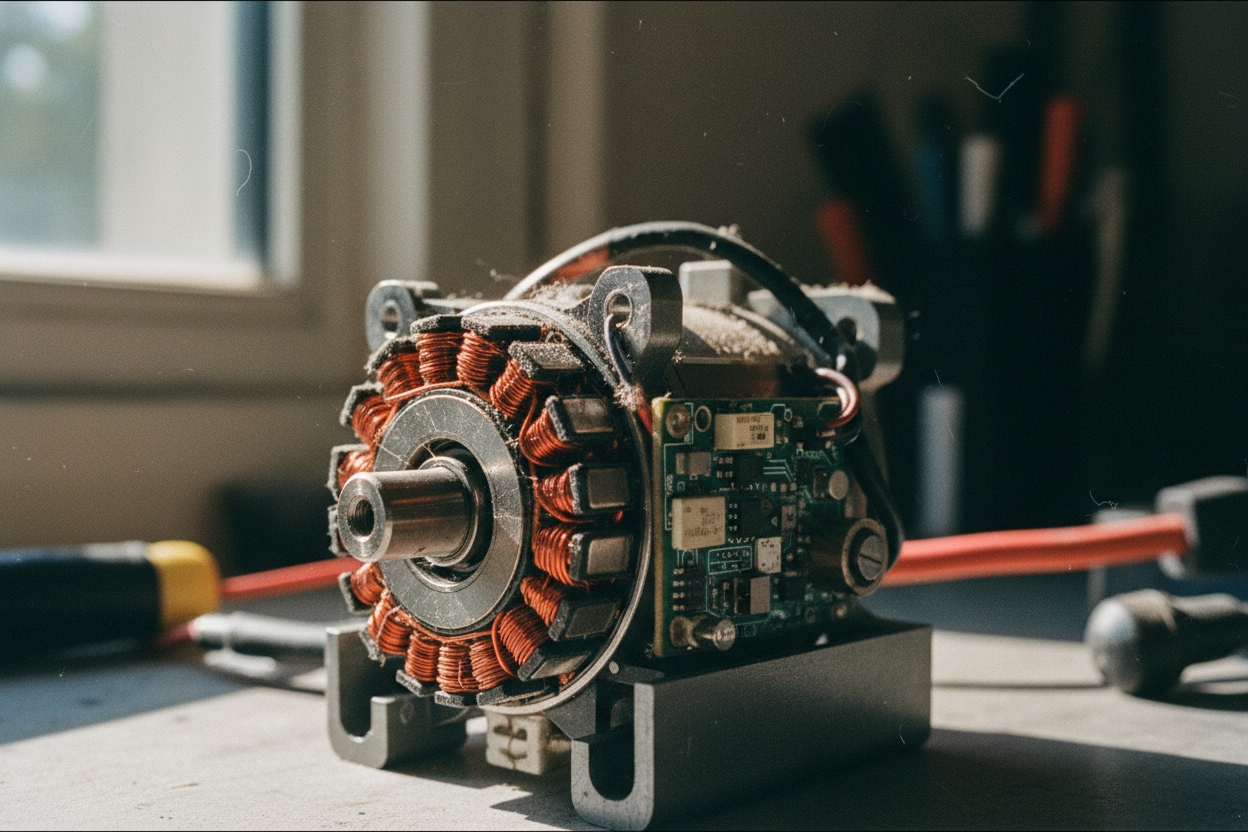
At their core, brushed motors and brushless motors convert electrical energy into rotational motion, but they handle commutation very differently. A brushed motor uses physical brushes and a commutator to switch current through the armature windings, creating a rotating magnetic field that turns the shaft. This design is simple, rugged, and easy to drive with basic voltage control. In contrast, brushless motors place permanent magnets on the rotor and fixed stator windings around it. An electronic controller sequences current through the stator, eliminating friction-prone brushes. The result is higher efficiency, improved power density, and cleaner operation. Without brushes, there is less internal arcing and reduced electrical noise, which can matter in sensitive systems. Brushed designs still shine for their simplicity, quick setup, and low initial cost, especially in straightforward motors applications. Brushless designs excel where longer lifespan, smoother control, and higher reliability are priorities, providing a foundation for precise and efficient motion across a wide range of uses.
Performance and Control
When comparing real-world behavior, torque, speed regulation, and control precision separate these two motor types. Brushed motors typically offer strong starting torque and a very direct throttle response using simple drivers, making them predictable and easy to integrate. However, they can exhibit more torque ripple and less efficient high-speed performance. Brushless motors pair with an electronic speed controller (ESC) to optimize commutation timing and current delivery, yielding smoother torque curves, quicker acceleration, and higher top-end efficiency. With sensor feedback or well-tuned sensorless algorithms, a brushless setup can maintain consistent RPM under varying loads and provide refined braking and regenerative options. The trade-off is added system complexity and the need for careful controller selection to match motor Kv, pole count, and load characteristics. For applications demanding precise positioning, quiet operation, or frequent speed changes, brushless systems often deliver superior responsiveness and energy use. For simple drives where basic on/off or variable voltage suffice, brushed motors remain a compelling, straightforward choice.
Maintenance and Durability
Maintenance needs often determine the practical cost of a drive. Brushed motors experience brush wear and commutator erosion over time, producing conductive dust and requiring periodic service or replacement. This can add downtime in continuous-duty environments and may affect performance as brushes age. Heat buildup is another consideration, as friction and arcing contribute to thermal stress. Brushless motors, with no brushes to wear, typically offer a longer service life and cleaner operation, limited mostly by bearings, insulation health, and thermal management. Their sealed designs better tolerate dusty or humid conditions common in industrial and outdoor settings. Noise and vibration are also factors: brushless drives often run quieter and with reduced electromagnetic interference, which can protect nearby electronics. Still, maintenance is not zero; keeping bearings lubricated, ensuring proper cooling, and monitoring controller settings are essential. If a system must run for long intervals with minimal intervention, the durability and predictable performance of a brushless platform generally outweigh its added control complexity.
Cost, Power, and Application Fit
A clear-eyed look at total cost of ownership helps frame the decision. Brushed motors usually win on upfront price and simplicity, needing only basic drivers and straightforward wiring. They can be ideal for low-duty tasks, temporary installations, or budget-limited builds. Over time, though, brush and commutator wear, efficiency losses, and heat can add energy and maintenance costs. Brushless motors demand an ESC, careful tuning, and sometimes more sophisticated power electronics, but they repay that investment with higher power density, better runtime on battery systems, and cooler, more reliable operation under sustained loads. Consider the duty cycle, available power supply, ambient temperature, space constraints, and noise limits. Portable tools, precision robotics, and high-cycle automation often benefit from brushless efficiency. Simple conveyors, intermittent actuators, and cost-sensitive fixtures may favor brushed designs. Matching motor and controller to the load profile—start-stop frequency, peak torque, and continuous torque—ensures the chosen drive delivers value over its entire service life.
Making the Right Choice
Choosing between brushless and brushed comes down to aligning performance, reliability, and budget with the realities of your project. Define the mechanical load first: required torque at speed, peak surges, and thermal margins. Next, clarify control needs: is fine speed regulation, gentle ramping, or precise position control essential? If the system must run quietly, efficiently, and for long stretches with minimal maintenance, a brushless solution paired with a well-matched ESC is often the best fit. If speed control is basic, runtime is limited, and initial cost is the primary constraint, a brushed motor can simplify integration and reduce parts count. Don't overlook integration details such as mounting geometry, shaft size, gearbox compatibility, cooling airflow, and available voltage and current. Finally, test early with representative loads to validate thermal behavior and efficiency. By weighing these factors, you can select the right motor architecture and build a dependable, cost-effective drive that meets your long-term goals.