Court-Ready: Agility Drills for Basketball Footwork and Speed
Get court-ready with proven agility drills to sharpen footwork, lateral quickness, and speed. Cues, progressions, and a sample workout inside.
Court-Ready Foundations: Basketball footwork starts with a disciplined athletic stance that lets you absorb force and redirect it without delay. Stand slightly wider than shoulder width with toes forward to subtly out, knees tracking over the second toe, hips back, spine neutral, chest tall, and eyes up. Keep pressure through the midfoot to forefoot so you can spring instantly while the heels lightly kiss the floor for balance. Think nose behind toes and maintain light, quiet feet. Build this base with simple, high-value drills: stance drops on a clap and stick, front-to-back and side-to-side line hops, pogo hops for ankle stiffness, and split-stance starts to groove your first step. Cue triple flexion at the ankles, knees, and hips, and pair it with efficient arm action from cheek to hip to time your rhythm. Keep ground contacts short, steps under the hips, and breathing smooth. Common fixes include avoiding straight knees, heavy heels, and flailing arms. This foundation protects joints, sharpens timing, and primes you for explosive, court-ready speed.
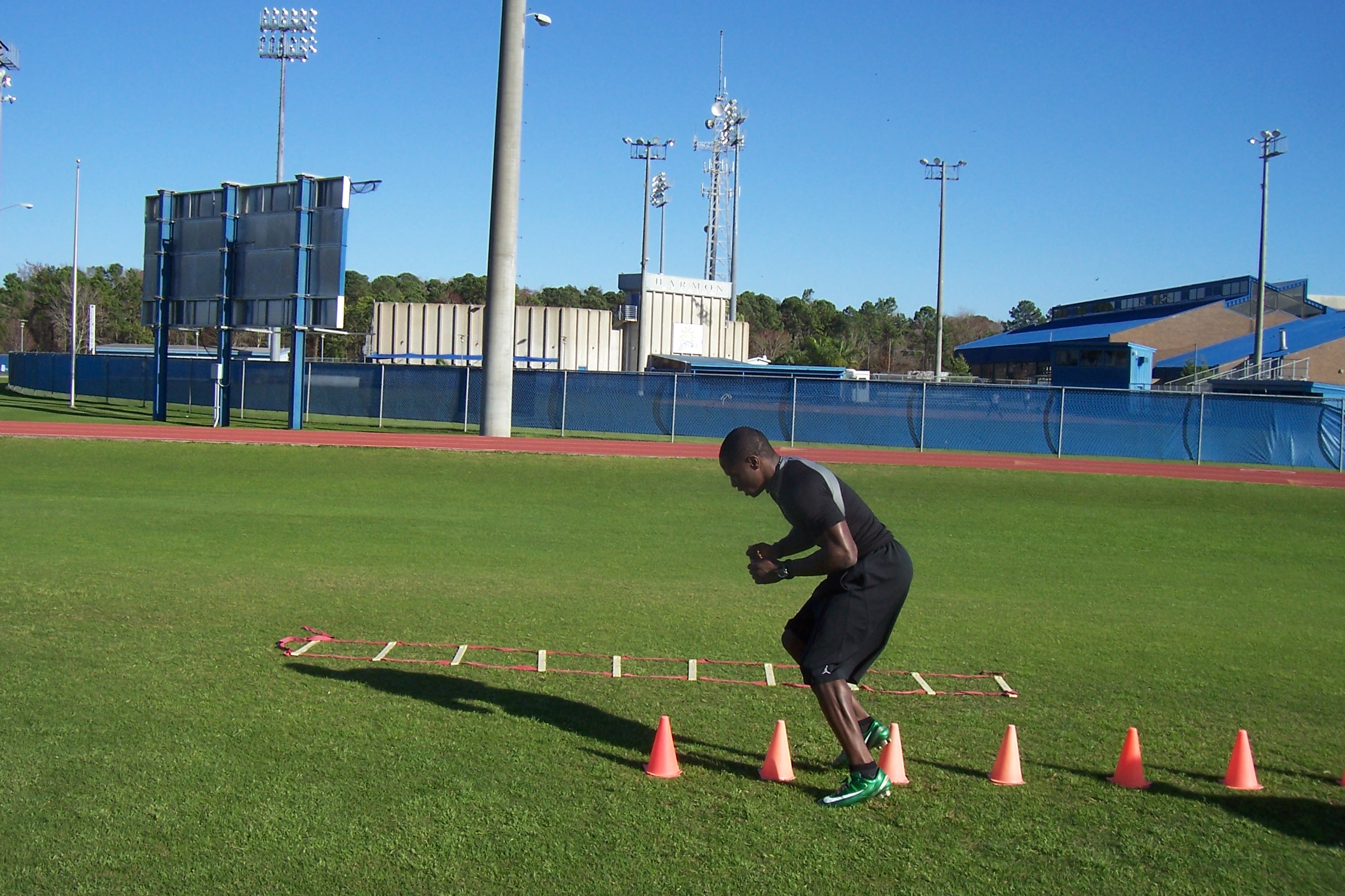
Ladder Literacy for Quick Feet: An agility ladder is a cadence teacher, not a dance floor. Use it to develop coordination, rhythm, and precise foot placement that transfers to cut-and-go basketball moves. Start with one-in, two-in, in-in-out-out, icky shuffle, and lateral high knees, keeping hips level, eyes scanning upcourt, and ankles dorsiflexed. Drive the arms and keep steps short to reduce airtime. Progress to forward entries with immediate reactive exits, adding a coach call to break left or right to a cone. Layer difficulty by dribbling, catching a pass at the last square, or finishing with a pull-up. Avoid overstriding, stomping heels, and staring at the ladder; you are training posture and posture under speed, not just fast toes. Aim for crisp contacts, chest tall, and shoulders relaxed. Quality beats volume: a handful of clean sets across varied patterns builds transferable quickness for crossovers, in-and-outs, and lateral escape dribbles without unnecessary fatigue.
Cone Change-of-Direction Mastery: Use cones to hardwire braking and reacceleration mechanics that win space on every possession. Map out a 5-10-5 style shuttle, a T-drill, a Y-drill, and figure-eight cuts to rehearse help-and-recover patterns and wing closeouts. Emphasize deceleration first: lower before you slow, keep the chest over the thigh, and place the plant foot slightly outside the center of mass with the shin angled toward the new direction. Hit a strong penultimate step to absorb force, then stick the cut and explode with two to three rapid piston steps. Choose a hip turn when opening to chase and a pivot when you must preserve position. Common errors include rounding cuts, popping tall during the brake, and crossing feet on shuffles. Make each rep basketball-specific by picking up a dribble at the plant, receiving a pass at the turn, or finishing at the rim. Use generous rest for maximal intent, protect angles, and track sharpness over raw time.
Defensive Footwork: Slides, Closeouts, and Containment: Elite defense rides on relentless angles and disciplined defensive slides. Build with lane slides, box slides, and zigzag patterns, focusing on a push-step mechanic rather than a step-pull. Keep the base wide, butt low, chest tall, and hands active without reaching. Add mirror drills and shadow-and-tag games to sharpen reactive lateral bursts. For the closeout, sprint most of the distance, then chop steps to decelerate under control, one hand high to contest and the other ready to deter the drive. Use a quick drop step to seal middle or baseline, and switch to a hip turn only when beaten to recover without crossing up. Integrate backpedal-to-hip-turn transitions and rebound pursuit to reinforce second efforts. Address common errors: drifting past shooters, clicking heels, and bending at the waist. Progress to live reads with shot fakes and first-step drives, maintaining posture and short ground contacts. Defense demands discipline, so protect form while building repeatable, game-speed reps.
Reaction, Plyometrics, and Smart Programming: Court speed becomes dangerous when it is reactive. Use partner cues with colors or numbers, a clap or verbal call, and tennis ball drops to trigger a cut, slide, or sprint without preplanning. Blend in ball handling, such as two-ball pounds into a cone call, or dribble live into a Y-decision finish. Add low-dose plyometrics like pogo hops, skater bounds, split jumps, and lateral box step-offs with a stick to refine landing control and elastic pop. A simple micro-session flows from warm-up and mobility for ankles, hips, and adductors, to activation with mini-bands, to neural prep with line hops, then a core block of two ladder drills, two cone drills, and one defensive drill, plus a reactive finisher and a short cool-down. Keep sessions short, two to four times per week, prioritizing sharpness over sweat. Train on a safe surface with grippy shoes, use cones or tape if you lack equipment, and log notes on control, speed, and decision quality to guide steady progression.