Motor Efficiency: How to Cut Waste and Boost Performance
Motors devour energy, but smarter sizing, drives, power quality, and maintenance can slash losses and lift output. Here is how to do it right.
Understanding What Efficiency Really Means
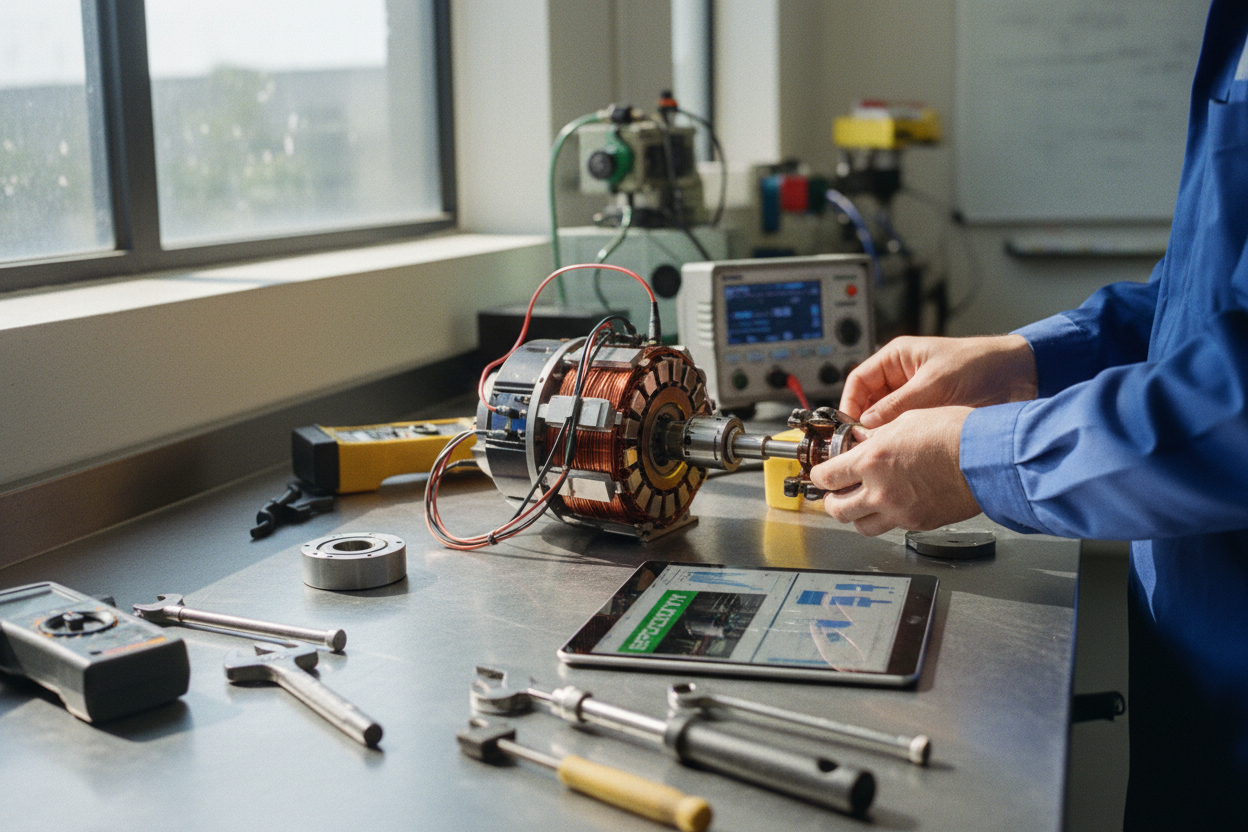
In the world of motors, efficiency is the share of input power that becomes useful mechanical output, rather than disappearing as losses. Those losses come from copper losses in windings, core (iron) losses in magnetic materials, mechanical friction and windage, and stray-load effects that grow with load. Reading a nameplate gives a snapshot, but real performance depends on duty cycle, ambient conditions, and how closely the motor's torque-speed curve matches the job. A motor that is too big or too small for its task converts more energy into heat than motion, hurting efficiency and reliability. Understanding where watts go is the first step to getting them back. Map the path from the mains to the shaft, including drives, gearboxes, and couplings, and quantify each loss. Use accurate power measurements and load profiling to reveal hidden waste. With this foundation, every decision about sizing, controls, and maintenance becomes a lever for cutting waste and boosting performance.
Right-Sizing and Load Matching
Selecting the right motor is about load matching, not just maximum horsepower. Motors tend to reach peak efficiency near the band where they regularly operate; running far below that band means the motor idles on electricity, producing heat instead of torque. Oversizing is common because it feels safe, but it invites light-load losses, frequent starts and stops, and poor power factor. Start with a measured load profile that captures normal, peak, and transient demands, then size for the real job with a sensible service factor. Consider motor topology: induction, permanent-magnet synchronous, and reluctance designs each balance efficiency, cost, control complexity, and maintenance differently. For conveyors with steady torque, traditional induction can excel; for variable-torque pumps and fans, a high-efficiency design paired with smart speed control shines. Also consider the environment: cooling airflow, dust, and moisture affect heat dissipation and thus losses. Getting sizing right reduces capital cost, trims energy use, and extends equipment life.
Clean Power and Electrical Integrity
Even a well-chosen motor wastes energy when fed poor power quality. Voltage unbalance across phases creates uneven currents that inflate I²R losses and run the motor hot. Harmonics from non-linear loads distort waveforms, reduce power factor, and increase heating in windings and transformers. Tackle the source: balance single-phase loads across phases, size conductors to limit voltage drop, and ensure tight connections and solid grounding. Use power factor correction and, where needed, active filters to curb harmonics. Keep upstream protection and contactors appropriate to motor inrush and fault currents to avoid nuisance trips that encourage wasteful workarounds. For long cable runs, assess cable capacitance and reflected wave issues, especially with drives, and select suitable cable and output filters. Document and periodically audit the power path, from supply to terminals, with power analyzers. Clean, stable electrical conditions shrink losses, enhance reliability, and set the stage for control strategies to deliver their full efficiency gains.
Smart Speed Control and VFD Strategy
The easiest watts to save are the ones you never draw, and variable frequency drives (VFDs) let you tailor speed to demand. For pumps and fans, the affinity laws show that modest speed cuts can yield large power reductions, avoiding the waste of throttling or dampers. Use closed-loop control with well-tuned PID to hold process variables steady without hunting that causes unnecessary accelerations. Choose control modes wisely: vector control improves low-speed torque and efficiency, while soft starters limit inrush but do not provide ongoing variable speed benefits. Manage minimum speed to maintain motor cooling and consider external fans when operating slowly for long periods. In regenerative applications with frequent deceleration, evaluate braking choppers or regenerative drives to recover energy safely. Protect the motor from dv/dt stress with output filters where cable runs are long. When a VFD is right-sized and well tuned, it becomes a precision valve for electrons, delivering measurable energy savings.
Mechanical Health and Predictive Maintenance
Electrical excellence cannot overcome mechanical drag. Bearings, alignment, lubrication, and balance dictate how much of the motor's work reaches the load. Misaligned shafts and over-tensioned belts add constant parasitic torque, while dry or contaminated bearings convert energy into heat and noise. Keep couplings within specification, align with laser tools, and follow a disciplined lubrication schedule based on environment and speed, not just calendar intervals. Choose efficient gearboxes and maintain proper oil viscosity to reduce churning losses. Clean cooling paths and verify that fans and shrouds are intact so winding temperatures stay in the sweet spot for low resistance and long insulation life. Move from reactive fixes to predictive maintenance: monitor vibration, thermal signatures, ultrasound, and motor current analysis to detect faults early. By addressing mechanical inefficiencies promptly, you lower load, guard against cascading failures, and keep the motor operating where its efficiency curve is highest.
Whole-System Thinking and Continuous Improvement
A motor rarely works alone; it is part of a system where design choices upstream and downstream set the ceiling on efficiency. Optimize the driven equipment: select high-efficiency impellers, reduce piping and duct restrictions, streamline valves, and eliminate unnecessary bends that force the motor to fight friction. Replace throttling with variable speed, add bypass loops sparingly, and coordinate controls so assets do not compete. Track meaningful KPIs such as kWh per unit produced and overall equipment effectiveness, linking energy to throughput and quality. Commission thoroughly, verify calibration, and document setpoints. Use energy audits, data logging, and periodic tuning to adapt as processes change. When retrofitting, evaluate lifecycle cost and payback, not just nameplate ratings. Train operators to recognize energy-wasting behaviors and empower them with clear dashboards. This system mindset turns isolated tweaks into compounding gains, cutting waste and boosting performance across the entire motor-driven operation.