Two-Stroke vs Four-Stroke Motors: What Sets Them Apart
From power strokes to maintenance, here's how two-stroke and four-stroke motors differ in design, performance, efficiency, emissions, and best uses.
Power Cycle Fundamentals
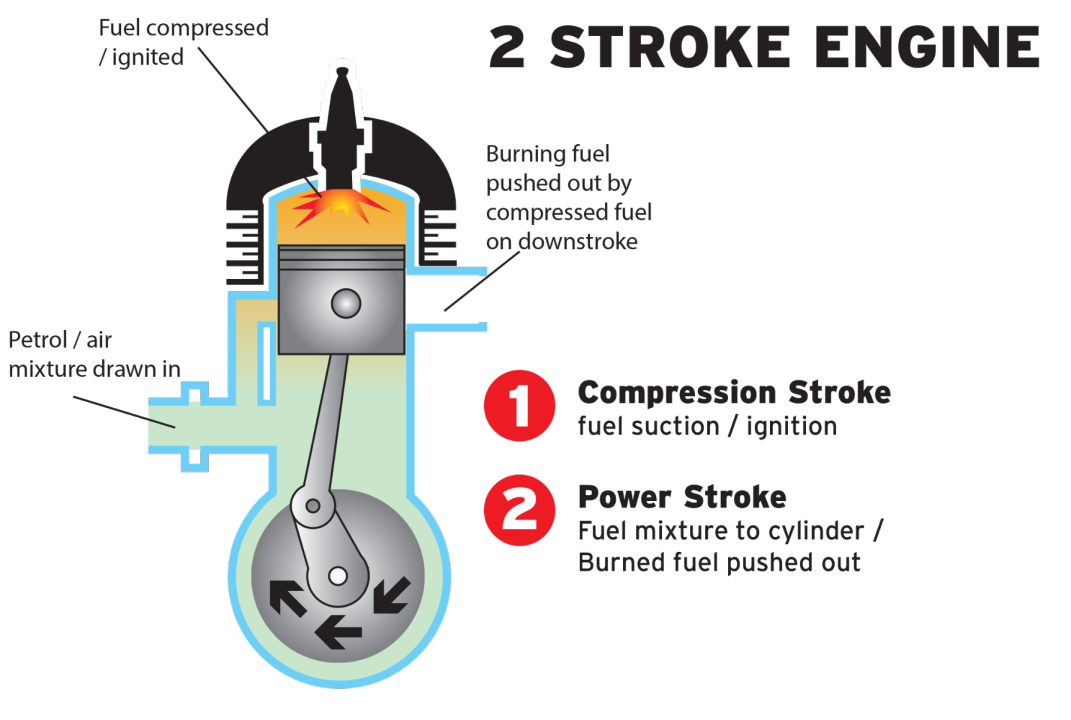
Understanding how a two-stroke and a four-stroke motor turn fuel into motion starts with the power cycle. In a four-stroke, the piston completes four distinct strokes—intake, compression, power, and exhaust—over two crankshaft rotations. In a two-stroke, those events are combined so that every downstroke delivers power, with intake and exhaust handled by ports uncovered by the piston. The result is a power pulse on each revolution, a defining trait of the two-stroke. Four-strokes use valves actuated by a camshaft to control gas flow, promoting precise timing and clean combustion. Two-strokes often rely on crankcase compression and reed valves to move the charge, reducing part count and mass. These mechanical differences shape everything that follows: how a motor breathes, how it lubricates itself, and how it wears over time. Whether the application is a compact handheld tool, a lightweight bike, or a steady-duty generator, grasping the cycle explains why these motors feel, sound, and deliver power so differently.
Combustion, Efficiency, and Fuel Use
The way each design manages air, fuel, and lubrication drives overall efficiency. A four-stroke separates the oil in a sump from the combustion chamber, minimizing oil burn and enabling cleaner, more complete combustion. A two-stroke typically blends oil with fuel or meters it into the intake, which simplifies parts but can allow a portion of unburned mixture to escape during scavenging. This short-circuiting is central to the classic two-stroke character—snappy response and impressive output for size—but it usually means higher fuel use per unit of work. Four-strokes, with controlled valve timing and reduced charge loss, often achieve superior fuel economy and smoother part-throttle behavior. Modern tuning approaches can improve two-stroke scavenging and reduce waste, while four-strokes benefit from optimized intake and exhaust geometry. In everyday terms, expect a two-stroke to trade some efficiency for immediacy and lightness, while a four-stroke trades mass and complexity for steadier burns and predictable range between refills in many motors applications.
Power Delivery and Ride Feel
Two-stroke and four-stroke motors deliver power with distinctly different personalities. The two-stroke is renowned for its high power-to-weight ratio and a lively surge when it enters the strongest part of its rev range. This can feel exciting and urgent, with rapid throttle pickup that rewards aggressive inputs and quick transitions. The four-stroke counters with broader torque spread, stronger low-end pull, and a more linear relationship between throttle and acceleration. That steadiness helps with traction, stability, and control, particularly when load or terrain varies. Four-strokes also provide engine braking, useful for speed control without riding the brakes, while two-strokes tend to freewheel more, which can be an advantage in maintaining momentum. Vibration and sound differ, too: the crisp bark of a two-stroke contrasts with the deeper cadence of a four-stroke. Balancing systems, exhaust tuning, and gearing can refine feel, but the core delivery remains: peaky and lightweight versus tractable and planted.
Maintenance, Service, and Longevity
Ownership experience hinges on maintenance habits and component complexity. A two-stroke often has fewer moving parts—no valvetrain, fewer seals, and typically lighter assemblies—making it approachable for DIY top-end rebuilds such as piston and ring service. The tradeoff is that high-output two-strokes may need more frequent inspections, decarbonizing of exhaust ports, and attention to mixture and spark plugs. A four-stroke adds cams, valves, timing chains or belts, and a pressurized oil system that requires regular oil and filter changes. Valve clearance checks, while less frequent, demand precision and can extend shop time. In many use cases, a well-maintained four-stroke offers long service life with extended intervals, whereas a two-stroke emphasizes simplicity and quick tear-downs. Costs balance differently: consumables and oil changes on four-strokes versus more periodic top-end parts on two-strokes. Your tools, skills, and willingness to follow a schedule often determine which platform feels more reliable over the long run.
Emissions, Noise, and Environmental Footprint
How a motor treats the intake charge influences emissions and sound. A two-stroke typically burns a measure of oil with the fuel and can allow unburned hydrocarbons to exit during scavenging, producing a characteristic haze and aroma under load. A four-stroke, with dedicated oiling and controlled valve events, keeps the charge in the chamber longer, generally resulting in cleaner exhaust and reduced visible smoke. Noise signature also differs: two-strokes emit a sharper, higher-frequency note, while four-strokes tend toward a lower, muffled pulse. Exhaust design, packing quality, and spark arrestors affect both categories, and thoughtful tuning can meaningfully lower the sound footprint. Fuel quality and correct jetting or mapping help minimize deposits and plug fouling. For users sensitive to neighborhood impact, long operating sessions, or enclosed work areas, the steadier combustion of a four-stroke often wins. For short, outdoor, high-output bursts, the compact energy of a two-stroke remains compelling despite its environmental compromises.
Choosing the Right Motor for Your Needs
Selecting between two-stroke and four-stroke motors is a matter of priorities. If you value minimal weight, instant response, and straightforward mechanical layouts, a two-stroke shines in portable tools, lightweight performance machines, and scenarios where you carry the motor or need rapid bursts of power. If you prize fuel efficiency, broad torque, quiet steadiness, and longer intervals between services, a four-stroke is often the better everyday partner for commuting, utility work, and continuous-duty tasks. Consider a checklist: required runtime, load variability, noise sensitivity, maintenance style, parts availability, and total cost of ownership. Think about starting ease, cold-weather behavior, and how often you can service the equipment. Visualize real use cases—a trail ride with frequent throttle changes, a generator humming along at steady speed, a boat that needs predictable pull against current. Align those needs with the inherent traits of each design, and the right motor will usually announce itself clearly.